Brain Health Snapshot
A short educational questionnaire screening your three core networks — Default Mode, Salience and Central Executive — with a personalised starting protocol.
- No card required
- ~10 minutes
- Personalised protocol emailed
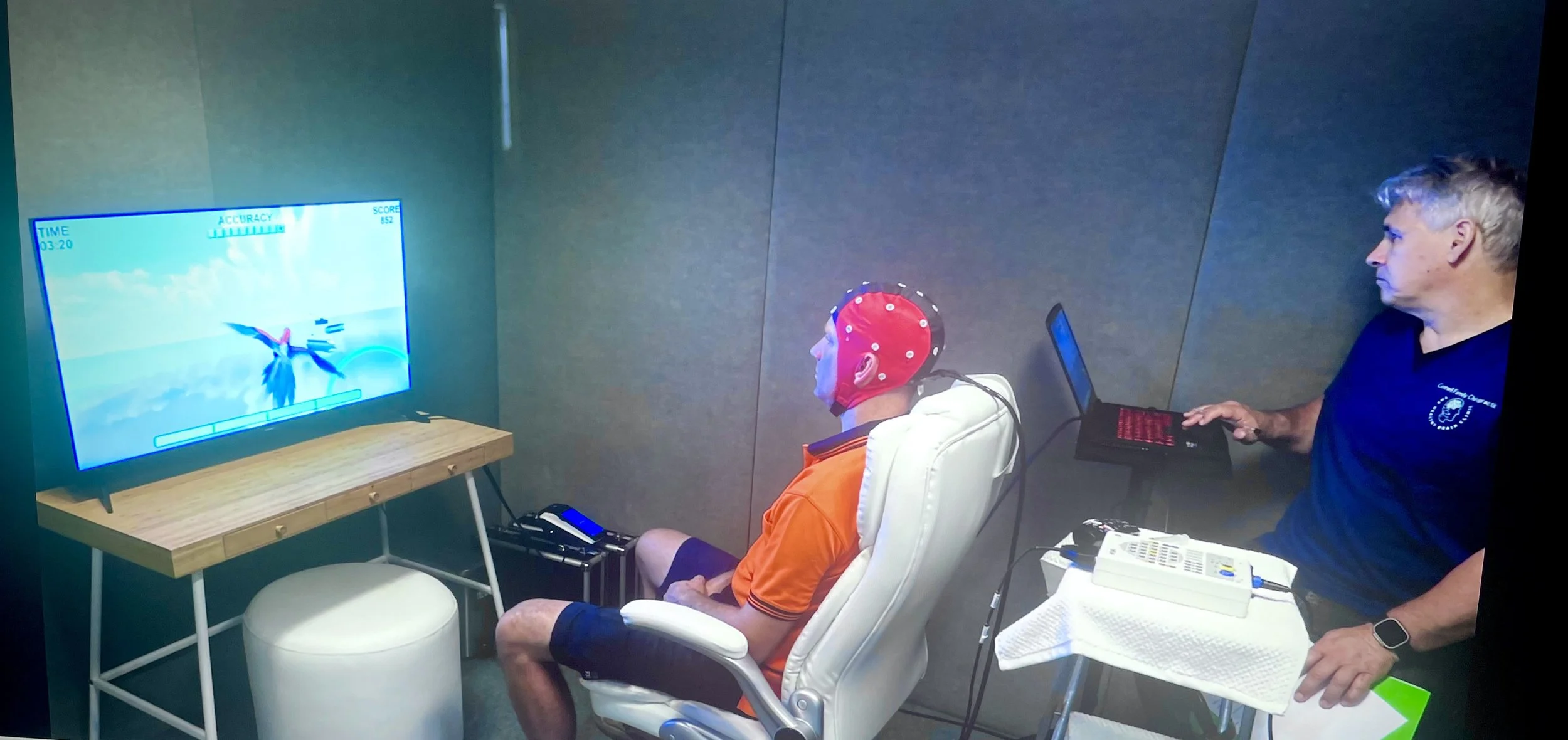
Operant-conditioning training of the brain's electrical activity. The patient sits quietly while their EEG is fed back into a screen, sound, or game. Over sessions, the brain learns to spend more time in the patterns the protocol encourages.
Sensors on the scalp record electrical activity at specific sites. Software identifies the EEG features the protocol is targeting — typically based on the patient's qEEG findings — and rewards the brain when it produces them. Reward usually means the screen brightens, a tone plays, or a game character moves. Nothing is put into the brain. The brain does the work — the feedback is simply a mirror.
A session is 30–45 minutes, run weekly. A typical programme runs ~10 sessions over 12 weeks, with a reassessment qEEG at week 11 and a side-by-side comparison report at week 12.
The neurofeedback evidence base has grown steadily — not uniformly. The strongest signal is in attention presentations, where multiple meta-analyses including Riesco-Matías et al. (2021) and Van Doren et al. (2019) report sustained effects on inattention. Anxiety presentations show consistent within-subject effects, particularly when paired with HRV biofeedback. PTSD evidence includes van der Kolk et al's 2016 randomised trial, supporting use as adjunct to trauma-focused psychotherapy.
It is not, in any of those settings, a stand-alone substitute for established first-line care. We use it the way the evidence supports — as a measurement-led adjunct.
We don't run packaged protocols. Every neurofeedback plan is built from the patient's qEEG findings — which sites, which frequencies, which directions of change — and reviewed by Dr Ash before training begins. Most patients run surface-based protocols; some run swLORETA-guided z-score training where the picture warrants the additional precision.
Progress is tracked at every session against pre-defined targets, with a reassessment qEEG at week 11 compared side-by-side against your baseline — and a patient-friendly report at week 12.
We work alongside — not in place of — primary medical and psychological care. We do not diagnose neurological or psychiatric conditions from EEG, and we do not prescribe or alter medication. If you or someone you know is in crisis, call 000 or Lifeline 13 11 14.
The same methodology, every tier
14 brain networks. Quantitative measurement at the start, the middle, and the end. Co-care with your GP and psychologist — we work alongside, not instead of.
19-channel quantitative EEG, processed against age-matched norms via NeuroGuide. swLORETA source localisation maps activity to specific networks.
swLORETA-guided neurofeedback paired with HRV biofeedback at resonant frequency. Network-targeted protocols, not one-size-fits-all.
qEEG comparison at mid-cycle and end of programme. If the data isn’t moving in the expected direction, we change the plan — not the calendar.
One methodology across every tier — from the free Snapshot through to the in-clinic 12-week programme.
Four tiers of care
Every tier uses the same methodology — examination first, then targeted intervention. Choose the depth that fits your concern, your timeline, and your budget.
A short educational questionnaire screening your three core networks — Default Mode, Salience and Central Executive — with a personalised starting protocol.
Full 14-network mapping, 16-region BRLF screening, a 30-day guided programme and content library — 30 days of access.
Real-time HRV biofeedback at home in the NeuroZen app, the full 14-network assessment, a daily 3-minute diary, AI-driven weekly feedback and monthly progress reports.
In-clinic qEEG at the start and again at week 11, a weekly in-clinic visit for 12 weeks, personalised swLORETA neurofeedback, and a clinician-led plan designed by Dr Ash.
All tiers complement, not replace, your GP, psychologist, or psychiatrist. We co-care.
Two ways to begin
Examination, not assumption.
Take the free Brain Health Snapshot to orient yourself, or book a consultation with Dr Ash Connell. Both are easy to step away from, and either way you’ll leave with a clearer picture of what’s actually going on.
Or call (03) 5593 2934 — reception will take a few details and call you back within one business day.